What does a plain BTC grid earn before February 2026?
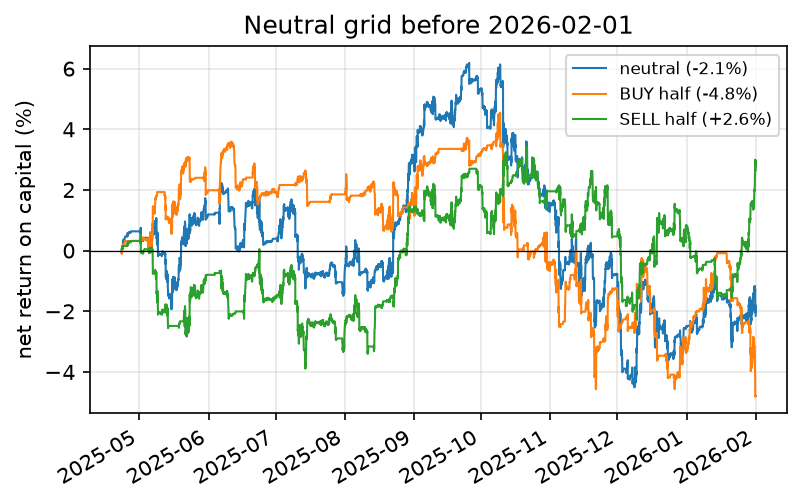
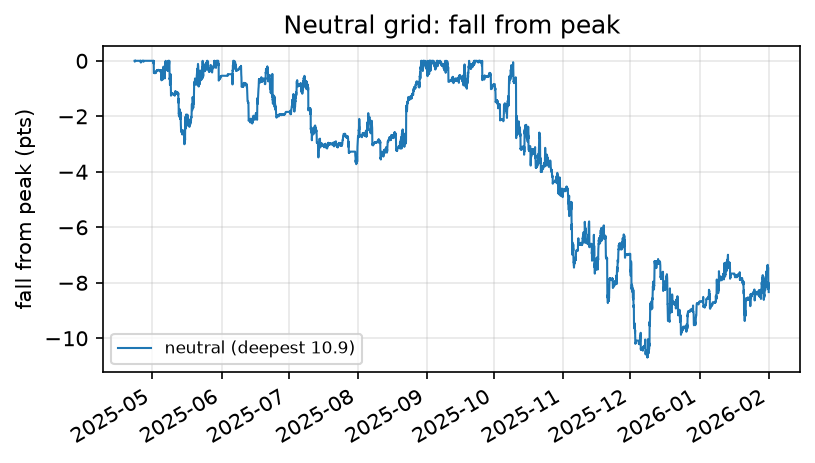
A neutral grid that both buys and sells loses 2.1% over nine months, with a worst fall of 10.9 points. It trades 229,000 USDT on 1,000 USDT of capital, and would break even only if the exchange's maker fee were 0.008% or lower, against 0.02% normally.
What a grid is
A grid places a ladder of orders around the current price. A buying grid puts buy orders below the price; each time one fills, it places a sell order one step higher, so every dip and bounce earns one step. A selling grid does the mirror. When price runs away from the ladder in one direction, the grid stops and closes what it holds.
The grid here copies how Hummingbot's grid executor works, the same software the PekkaLabs Condor setup uses. It was checked with small hand-made price paths before being run on real data.
Why measure a plain grid first
pak Yon wants to test a grid whose side follows LB6. To know whether LB6 helps, there must first be a grid that follows nothing. This "neutral" grid runs a buying grid and a selling grid side by side, 500 USDT each, all the time.
How it was run
- BTC perpetual futures prices, minute by minute, from Binance's public archive, 23 April 2025 to 1 February 2026. Later data is kept aside for the final test.
- Steps of 0.5% between orders, because BTC typically moves 0.46% in an hour; the ladder spans 3% each way, because BTC typically moves 2.6% in a day. These were set once from the data, not tuned.
- Fees: 0.02% on resting orders (maker), 0.05% when a grid closes at market (taker), the normal Binance futures rates.
Results
| neutral grid | buying half | selling half | |
|---|---|---|---|
| return on 1,000 USDT | -2.1% | -4.8% | +2.6% |
| worst fall from peak | 10.9 pts | 10.0 pts | 5.9 pts |
| volume traded | 229,000 USDT | 114,000 | 116,000 |
| completed round trips | 1,764 | 877 | 887 |
BTC fell 15.9% over this window, which explains why the selling half earned and the buying half lost.
What it means
On its own, a plain grid trades a lot, about 24,000 USDT a month per 1,000 USDT, but does not make money at normal fees. The volume is there; the profit has to come from somewhere else, which is exactly pak Yon's idea: let LB6 choose the side.
The next step tests a simpler direction first: does a buying-only grid do better than this neutral one?
Later check: this number depends on when the grid starts
A later report, "How much does a simulated grid's result depend on when it starts?", ran the same grid from each of the 24 hours of 24 April 2025. The nine-month return ranged from -15.5% to -3.7%, with a middle value of -6.5%. The -2.1% above, from a start at midnight on 23 April, sits at the lucky end. The conclusion holds and is stronger: at normal fees this grid loses money; how much depends heavily on where the first grid was placed.
Limits
- The grid is a model of Hummingbot's executor on minute bars, not the executor itself; fills inside a minute are approximated.
- One parameter set only. A different step or range would give different numbers.