How much does a simulated grid's result depend on when it starts?
A lot. Starting the same plain grid at a different hour of the same day moved its nine-month return anywhere from -15.5% to -3.7%. The grid that follows LB6 swings too when its own timing is shifted, but in 11 of 12 shifted runs it still beat the best plain grid on the test data.
What a grid is, and why its start matters
A grid places a ladder of orders around the current price and earns a small step on each dip and bounce. When price leaves the ladder, the grid closes, and a new grid starts at the price where the old one ended. So where the first grid is placed decides where the second one is placed, and so on: every later grid depends on the first.
All earlier grid reports simulated one run each, starting at the first minute of their data. That is one draw. This report asks how different the answer would have been from a different first minute.
The grids are the ones from earlier reports: a neutral grid (a buying grid and a selling grid side by side, 500 USDT each), a long-only grid (buying only, 1,000 USDT), and the grid whose side follows LB6 (buying while LB6, PekkaLabs's 6-engine BTC system, is net long, selling while it is net short, nothing while it is flat). Same settings as before: steps of 0.5%, a ladder spanning 3% each way.
How it was measured
- 24 start times: every hour of the first day of a window, 00:00 to 23:00 UTC. Every run ends at the same time.
- Before February 2026: starts on 24 April 2025, end 1 February 2026.
- February to August 2026, the data kept aside for the test of the grid that follows LB6: starts on 1 February 2026, end 26 August. That test was already done; this is a check of how sturdy its result was, made after the fact, and it does not change it.
- Efficiency is total return divided by the worst fall from a peak (both in percentage points of the 1,000 USDT capital), as in the earlier reports.
- "Middle" below means the median: half the runs did better, half worse.
- This check was not planned blind: it started when six start times, seen by accident, gave very different answers.
A plain grid's result is mostly where it started
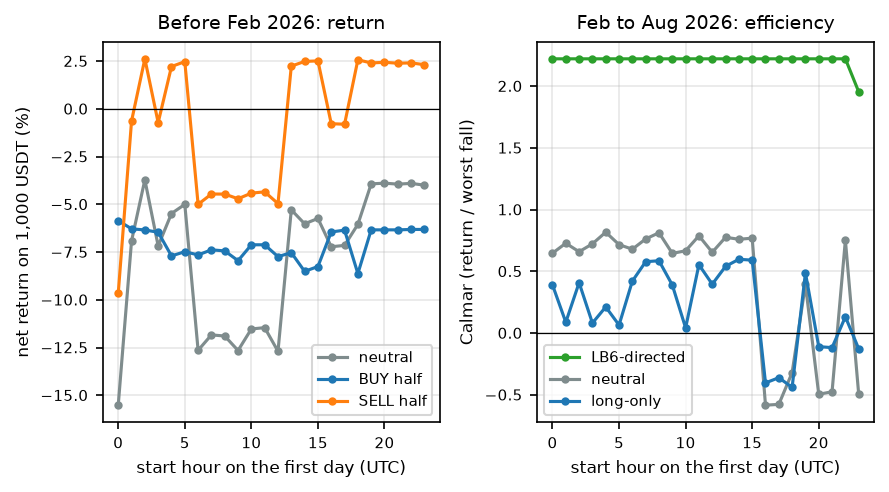
Before February 2026, the neutral grid made between -15.5% and -3.7% depending only on the start hour; the middle of the 24 runs was -6.5%. Its selling half alone ranged from -9.7% to +2.6% (in % of the 1,000 USDT total), so even whether the selling half made money depended on the start.
The earlier report on the plain grid gave -2.1%. That run started one day earlier, at midnight on 23 April, and it is better than every one of these 24 runs. Its result was at the lucky end; the middle of these 24 runs, -6.5%, is a fairer figure for that grid on that data, though starts spread over more days might move it again.
Shifting the start hour cannot move the grid that follows LB6
The grid that follows LB6 places a new grid each time LB6 changes direction, so its grids are anchored at LB6's moments, not at the start of the data. LB6 first took a side at 22:00 on 1 February, so every run started at or before 22:00 was the same run. Shifting the start hour therefore tests the plain grids, not this one:
| on February to August 2026, over 24 start hours | lowest | middle | highest |
|---|---|---|---|
| efficiency, neutral grid | -0.58 | 0.67 | 0.82 |
| efficiency, long-only grid | -0.44 | 0.30 | 0.60 |
| return, neutral grid | -6.0% | +5.1% | +6.2% |
| return, long-only grid | -5.8% | +3.2% | +6.3% |
Each row has its own lowest and highest start hour.
Shifting LB6's own timing moves it a lot, but it mostly still wins
To move the LB6 grid's anchors, the same test was run with LB6's direction acted on late: 0, 5, 10, up to 55 minutes after LB6 changed side. That is also a realistic question, since a live system never acts at the exact minute.
| delay | 0 min | 5 | 10 | 15 | 20 | 25 | 30 | 35 | 40 | 45 | 50 | 55 |
|---|---|---|---|---|---|---|---|---|---|---|---|---|
| efficiency | 2.22 | 2.62 | 0.75 | 3.11 | 3.34 | 4.83 | 3.98 | 2.54 | 2.83 | 2.05 | 1.81 | 1.23 |
Its efficiency ranges from 0.75 to 4.83, so the one figure from the original test (2.22) is a single draw for this grid too. But 11 of the 12 delayed runs are above 0.82, the best any plain grid reached at any start hour; only the 10-minute delay falls below.
What it means
- Numbers from one simulated run of any grid should not be trusted to a few percent. Grid comparisons from now on use many start times or delays and report the middle and the range.
- The earlier result, that a grid following LB6 beats a plain grid on the test data, survives this check in most runs, but its size is uncertain: anywhere from about the same as a plain grid to six times better. It is still one stretch of data, decided largely by its last week (see "Does a grid that follows LB6 beat a plain grid?"), and LB6 itself was tuned on data that may overlap it.
Limits
- 24 start times within one day, and 12 delays within an hour. Starts spread over several days would shift the plain grids further.
- The delay check was added after a first reading of this report, not planned in advance.
- The grid is a model of Hummingbot's grid executor on minute bars, not the executor itself.