Does order flow before an LB6 entry say anything about how the trade will go?
Not on the data so far. In the hour before LB6 enters, aggressive buyers and sellers are close to balanced, and trades entered against that hour's flow end only slightly worse on average than trades entered with it. That gap is small enough to be chance, and it points the other way in half of LB6's engines.
What LB6 is
LB6 is a BTC trading system at PekkaLabs with 6 small strategies, called engines. Three only go long (bet the price rises) and three only go short (bet the price falls). The engines decide from options data only. The data here is a simulation of the latest version, Config B.
What order flow is
Every trade on an exchange has a side that waits and a side that crosses the spread to trade at once. The crossing side is the taker. When takers are mostly buying, buyers are in a hurry; when they are mostly selling, sellers are.
Binance publishes, for every minute, how much of the volume was bought by takers. From that, the taker-buy share of an hour is the part of the hour's volume that takers bought. 0.5 means aggressive buying and selling were equal; above 0.5 buyers dominated, below 0.5 sellers did.
Why look at it
Order flow is information LB6 does not use. If a long entry made while sellers are dominating tends to go badly, flow could become a filter for LB6. The idea to test would be: trades entered against the last hour's flow are weaker. Before spending the data kept aside for decisive tests on that idea, this report looks at what flow does around LB6's entries on earlier data.
How it was measured
- Only trades entered before 1 February 2026: 201 trades. Later data is kept aside for decisive tests.
- Each trade's result is its net % return (after a 0.05% fee on each side); results are compared as averages per trade, and differences in percentage points (pp).
- For each trade, the taker-buy share of the 60 minutes before entry. One hour, because 323 of all 337 LB6 entries (96%, counting later data too) happen exactly on the hour: the engines act on hourly data, so this is the last full hour they could have seen.
- A trade is with flow if it is a long entered while buyers dominated, or a short entered while sellers dominated. Otherwise it is against flow.
- The difference between the two groups is also computed inside each engine and then averaged, weighting each engine by its number of trades, because the six engines differ a lot in how well they do and in how often they meet each kind of flow. A difference between engines should not pass as a difference due to flow.
Flow before entries looks like any other hour
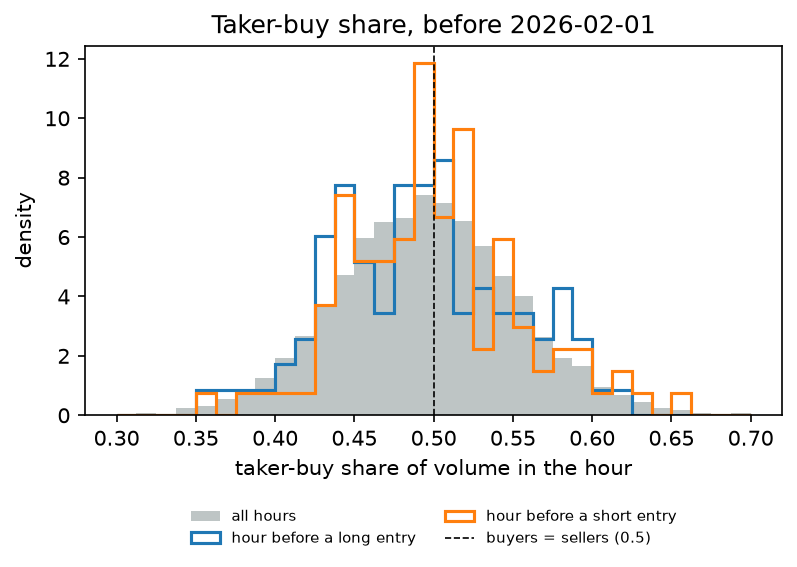
Over all hours, the taker-buy share is usually between 0.43 and 0.57 (10th to 90th percentile), with a median of 0.495. The hour before a long entry has a median of 0.490, before a short entry 0.496. LB6 neither waits for buyers before going long nor for sellers before going short. About half of its trades (103 of 201) are entered against flow.
Against-flow trades are only slightly weaker, and not in every engine
| mean result, with flow | +0.85% per trade |
| mean result, against flow | +0.67% per trade |
| difference, all trades together | -0.17 pp (could be anywhere from -0.69 to +0.41) |
| difference, inside each engine | -0.21 pp (could be anywhere from -0.75 to +0.41) |
The ranges in brackets are 95% confidence intervals: they show how far the difference moves when the trades are resampled. Both include zero, so the data cannot tell this gap from noise.
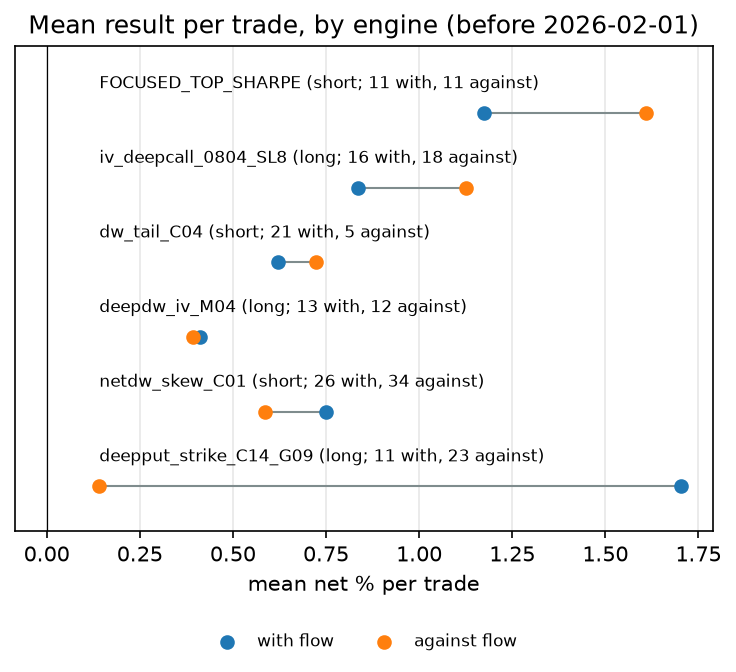
Inside the engines, against-flow trades are clearly weaker in two, about equal in one (-0.02 pp), and stronger in three. All of the overall gap comes from one long engine, deepput_strike_C14_G09: +1.70% on its 11 with-flow trades against +0.14% on its 23 against-flow trades. Without that engine, the difference inside engines is +0.07 pp, slightly in favour of against-flow trades.
A check added after these results, which does not cut at 0.5 but ranks how strongly flow agreed with each trade against how well the trade did, inside each engine, finds no relation either (rank correlation +0.03; per engine from -0.27 to +0.27: three positive, two negative, one zero).
What it means
Nothing here points to flow as a filter for LB6. That is not proof there is no effect: the ranges above still allow a gap about as large as a typical trade's whole result. But the only support for the idea is one engine out of six, picked after seeing all six, which is the kind of pattern that often disappears on new data. So the idea was dropped rather than spent on the held-aside data.
Limits
- One window (60 minutes) and one flow measure. Flow over a shorter or longer time, or measured as a change rather than a share, was not looked at.
- Half of all hours sit between 0.46 and 0.53, so many trades are only barely with or against flow. The ranking check above avoids that cut, and also finds nothing.
- Taker volume shows who crossed the spread, not who was right. Large orders split across many small ones look the same as many small traders.
- 201 trades, split six ways, leaves 22 to 60 trades per engine.