How much does LB6 trade, and how often does it point one way?
About 21 trades a month, or 42,500 USDT of volume per month for every 1,000 USDT it puts into a trade. It has a net direction 58% of the time: long 27%, short 31%, and no position at all the other 42%.
Why measure this
pak Yon wants to test a grid strategy whose side, buying or selling, is set by LB6, and to judge grids by how much they trade, because exchanges pay a rebate on volume. Before comparing grids, two plain numbers are needed: how much LB6 itself trades, and how often LB6 has a direction a grid could follow.
What LB6 is
LB6 is a BTC trading system at PekkaLabs with 6 small strategies, called engines. Three only go long (bet the price rises) and three only go short (bet the price falls). The data is a simulation of the latest version, Config B.
How it was measured
Only trades entered before 1 February 2026 are used: 201 trades over 284 days. Later data is kept aside for the final test of the grid idea, so no choice here can be tuned to it.
LB6's position sizes are not part of the data, so volume is given per 1,000 USDT position: each trade opens and closes once, which is 2,000 USDT of volume.
Net direction at a given minute is the number of long engines holding a position minus the number of short engines holding one. Above zero is net long, below zero net short, zero is flat.
Results
| trades per month | 21.3 |
| volume per month, per 1,000 USDT position | 42,500 USDT |
| time net long | 27% |
| time net short | 31% |
| time flat | 42% |
| typical net-long stretch | 12 hours |
| typical net-short stretch | 23 hours |
| direction changes per month | 30 |
| straight long-to-short flips per month | 0.4 |
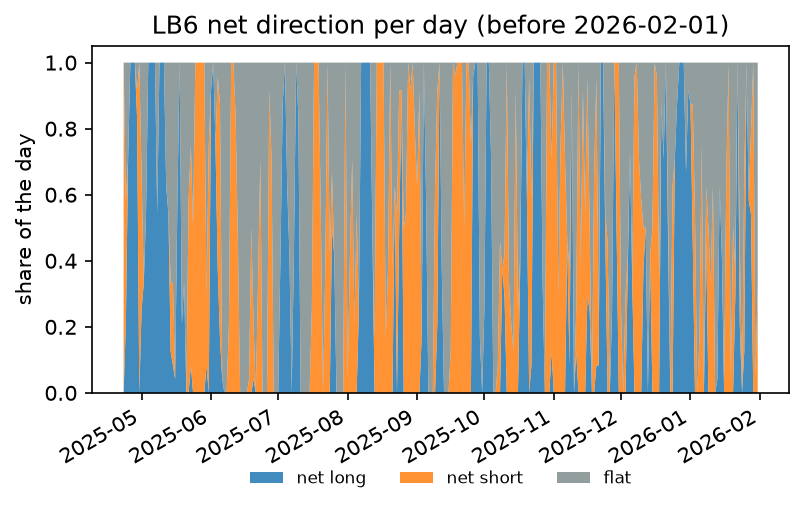
Almost every change of direction passes through flat first: LB6 goes from long to nothing to short, rarely straight from long to short.
What it means for the grid idea
A grid that follows LB6 would trade only 58% of the time and stand still the rest. It would start and stop about 30 times a month. Those restarts matter: every stop closes the grid's open position at market price, which costs a taker fee and gives up any unfinished round trips.
The next report tests that idea directly, on the data kept aside.
Limits
- Volume assumes 1,000 USDT per trade; real sizing would scale it.
- This is the simulated tradelist, not live trading.