Do Polymarket's 15-minute BTC traders react to BTC's price late?
Only by a few seconds. Trades on these markets match BTC's price from about 3 seconds earlier best. The minute-by-minute price history that looked a whole minute behind BTC is recorded late; it is not what traders actually paid. Trades that disagreed strongly with BTC's price still paid off on average, but only clearly when acted on at once, and that could not be checked against fees or available size.
What these markets are
On Polymarket, a prediction market, a recurring market asks every 15 minutes whether BTC's price at the end of the 15 minutes is at or above its price at the start. The Up share pays 1 USDC if so, the Down share pays 1 otherwise, so the Up price reads as the market's probability that BTC ends up. The report "Are Polymarket's 15-minute BTC prices honest probabilities?" found those prices match outcomes closely.
Why ask about speed
If traders on Polymarket update their prices tens of seconds after BTC moves on exchanges, someone watching BTC directly could buy the side that has just become likely, before its price catches up.
Polymarket's once-a-minute price history suggested exactly that: it matched BTC's price from a minute earlier better than BTC's price at the same moment, and a simple rule of buying when it disagreed with BTC showed +0.18 per share. But a history point recorded late would look the same. Individual trades, stamped to the second, tell the two apart.
How it was measured
- One market per day, picked at random, from September 2025 to August 2026: 353 markets with 861,420 trades inside their 15 minutes. Later markets are kept aside for a decisive test, so nothing here is tuned on them.
- BTC's price second by second from Binance's public archive (spot BTCUSDT). Chainlink's price, which settles these markets, averages exchange prices like this one.
- For each trade, a simple model probability that BTC ends up: how far BTC has moved since the market started, compared with how much it typically moves in the time left. It knows nothing about Polymarket.
- The model's sense of "typical move" comes from how much BTC moved second to second in the 15 minutes before the market opened.
- The model was computed with BTC's price taken 0, 1, 2, 3, 5, 10, up to 120 seconds before each trade. A delay of 0 uses the last full second before the trade. The delay at which the model best matches the trade prices is how far behind BTC the traders are.
- Trades near certainty are left out, since they say little about speed: a trade is kept only if both its Up price and the model, at every delay, are between 0.05 and 0.95. 671,059 trades remain.
Trades are about 3 seconds behind BTC
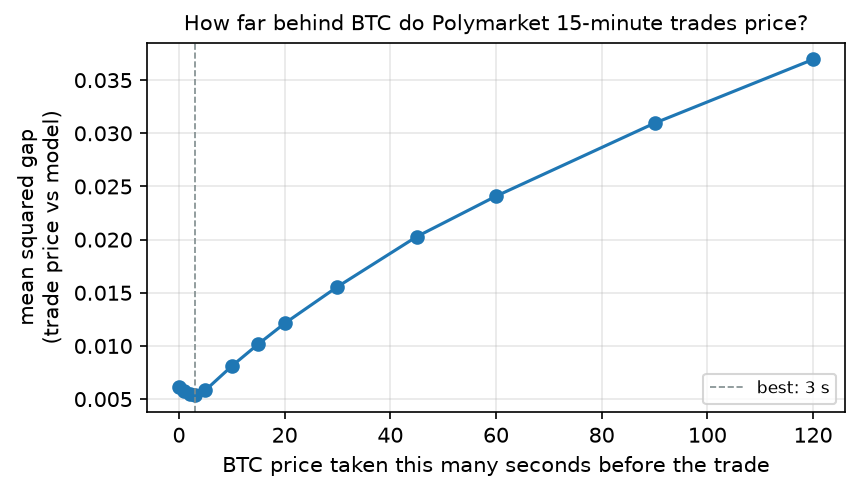
The gap between trade prices and the model is smallest when BTC's price is taken 3 seconds before each trade (mean squared gap 0.0053, against 0.0061 at no delay), and grows steadily with longer delays (0.0241 at 60 seconds). Market by market, among the 346 markets with at least 20 such trades, the best delay was 3 seconds in the middle case, and between 2 and 5 seconds for half of them.
So trades, on average, follow BTC within seconds. Some of those 3 seconds may be the delay between Binance and the feeds traders watch, not the traders themselves. The minute-old look of the price history therefore comes from how that history is recorded, not from slow trading, and the +0.18 per share seen on it is not something trades offered. That idea was dropped.
A small edge remains for the very fastest, if it is real
Some trades still happened at prices far from the model. The rule: when the model's probability is more than 0.10 above a trade's Up price, buy Up at that price; when it is more than 0.10 below, buy Down at that trade's Down price. "Reacting late" means the model reads BTC's price that many seconds before the trade, as a slower trader would. Different trades qualify at each delay, so the counts do not shrink in order:
| reacting this late | trades | average result per share | could be (95%) |
|---|---|---|---|
| at once | 98,501 | +0.09 | +0.02 to +0.16 |
| 2 seconds | 85,392 | +0.08 | -0.00 to +0.16 |
| 5 seconds | 91,239 | +0.05 | -0.02 to +0.13 |
A result of +0.09 per share means buying shares that pay 1 at, on average, 9 cents less than they turned out to be worth. The ranges come from resampling whole markets, because trades within a market move together.
This is an upper bound, not a strategy:
- Fees are not included.
- It assumes one could buy at that trade's price, in any size, at that moment. Polymarket's history does not keep the order book, so whether those prices were still on offer is unknown.
- The model is simple; some of these "disagreements" may be the model being wrong, not the market.
- Only reacting at once keeps the range above zero; at 2 seconds it touches zero. The three rows have overlapping ranges, so the decline with delay is a tendency, not a measured slope.
- The trades kept were already filtered on the model (between 0.05 and 0.95), and trades that disagree with the model are where the model is most likely wrong.
What it means
A strategy of trading Polymarket's short BTC markets against BTC's own price would have to react at once, within the same second, and could only be tested properly with the order book recorded live, from now on, together with the current fees. That test is recorded as the next idea, blocked until such data exists.
Limits
- One market per day (353 markets), not all of them.
- Binance's spot price stands in for Chainlink's settlement price; a difference of a second or two between them would shift the measured delay by about that much.
- The model's volatility comes from the 15 minutes before each market and may misjudge sudden changes.
- Trade data repeats some fills from both sides; repeats with the same transaction, price and size were counted once.