Does a portfolio of positioning rules, built the LB6 way, beat holding BTC from 2025?
No. Six rules, picked from 29,160 the way LB6's engines were picked, made money in every year from 2020 to 2024, including 2022 when BTC crashed. From January 2025 the portfolio went flat: -0.8% over 22 months, with a worst fall of 16 points, while holding BTC ended at -1.5% with a worst fall of 69 points. Its efficiency (return divided by worst fall) was just below zero and below holding BTC's, so the bet failed: 22 flat months show no edge, only a much smaller fall. All six rules turned out to share one idea: buy BTC when few trader accounts are long.
What was searched
PekkaLabs's LB6 system is six simple rules ("engines") found by trying many combinations of options-market measures and keeping the best. On their own, none of LB6's engines is convincing; together they are. This search applied the same process to public measures of how BTC futures traders are positioned, from Binance's archive:
- four positioning measures: the funding rate (what longs pay shorts), the 24-hour change in open interest (positions opened or closed), the long/short account ratio (trader accounts long per account short), and the taker buy share (the part of volume bought in a hurry);
- six context measures built from them or from price: BTC's 24-hour return and volatility, the 24-hour change in funding and in the long/short ratio, open interest against its 7-day average, and the taker buy share over 24 hours.
Each rule takes two measures, a cut-off for each (10th to 90th percentile of its values over 2020 to 2024), a direction (above or below), and a side (long or short), and holds for 24 hours after the rule was last true, with fees (0.05% each way) and funding included: 29,160 rules, searched on September 2020 to December 2024.
Two choices follow LB6 and fix a weakness of the previous search, which picked one rule that turned out to have one lucky year:
- A rule is scored by its efficiency, but taken as the middle (median) value over itself and the up to eight rules around it: the same two measures with each cut-off one step higher, lower or the same. A lone lucky cut-off cannot win this way.
- Six rules form the portfolio, like LB6's six engines: the best by that score, each on a different pair of measures, whose daily results are not too similar (correlation below 0.5). Each gets a sixth of the capital.
Everything was written down and agreed before the search ran. January 2025 to October 2026 was then used once to check the portfolio.
The portfolio on 2020 to 2024
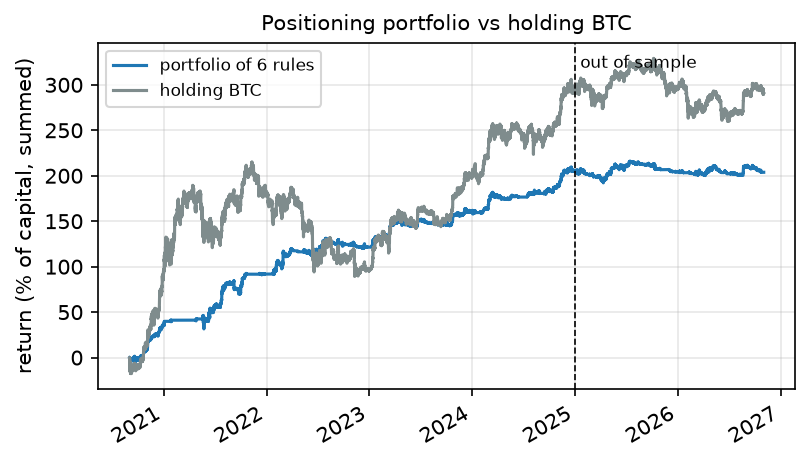
| portfolio | holding BTC | |
|---|---|---|
| return 2020 to 2024 | +205% | +292% |
| worst fall from a peak | 15 points | 126 points |
| efficiency (return / worst fall) | 13.8 | 2.3 |
It made money in every year, including +30% in 2022, when holding BTC lost 83 (returns here are hourly moves added up, not compounded). That is what the previous search lacked: the gains are not one episode.
How much of that is the search itself? Running the whole process on scrambled data, with the measures shifted in time against BTC's price, gave portfolios with an efficiency of 8.0 in a typical run and 11.3 at most, against 13.8 for the real one. So the real portfolio is better than what the search produces from noise, but the search alone already makes portfolios look good.
From 2025 it went flat
| portfolio | holding BTC | |
|---|---|---|
| return Jan 2025 to Oct 2026 | -0.8% | -1.5% |
| worst fall from a peak | 16 points | 69 points |
| efficiency | -0.05 | -0.02 |
The portfolio rose to about +10% by mid-2025, gave it back, and ended flat; it fell far less deep than BTC. Three of the six rules were positive on their own (+3.3%, +7.3%, and +0.6% on only 8 trades), three negative. The locked bar was an efficiency above zero and above holding BTC; it met neither.
What the six rules have in common
| rule (all long) | trades 2020-24 | efficiency 2020-24 | result 2025-26 |
|---|---|---|---|
| long/short ratio at most median, and 24-hour taker buy share in the top 10% | 155 | 15.8 | -2.6% |
| long/short ratio at most 60th percentile, and BTC's 24-hour return at most 60th percentile | 254 | 9.9 | -10.1% |
| funding rate in the bottom 20%, and long/short ratio in the bottom 30% | 95 | 10.9 | +3.3% |
| long/short ratio in the bottom 30%, and open interest relative to its 7-day average in its lower half | 121 | 6.6 | +7.3% |
| long/short ratio in the bottom 20%, and it fell sharply over 24 hours | 113 | 8.5 | -3.4% |
| long/short ratio at most median, and funding fell sharply over 24 hours | 108 | 4.3 | +0.6% (8 trades) |
Every rule is long, and every rule needs the long/short account ratio to be low: buy BTC when relatively few trader accounts are long. The portfolio had six rules but one idea. That idea held in every year from 2020 to 2024 and stopped paying from 2025.
In two rules, more than half of the 2020-2024 result came from their five best trades (53% and 58%); in the others, 20% to 38%.
What it means
- The LB6 process, applied to public positioning data, found one idea (go long when few accounts are long), not six. It was consistent for four years, somewhat better than what the search finds in noise (13.8 against up to 11.3), and has been flat for almost two. Its small fall since 2025 is the one attractive part.
- The two rules that stayed clearly positive from 2025 (low funding with few longs; few longs with open interest low relative to its weekly average) are the closest thing to candidates here, but they were picked by looking at 2025-2026, so only a forward run from now could test them.
- A next search should force the portfolio to hold different ideas (for example, at most two rules on the same measure, and short rules as well as long), the way LB6 mixes three long and three short engines.
Limits
- 2025-2026 had been used once before, by the previous search; it is not blind.
- One rule shape (two measures, 24-hour hold, no stop), one exchange, BTC only.
- Ten scrambled runs give a rough sense of how good the search makes things look, not a precise one.