Does a grid that follows LB6 beat a plain grid?
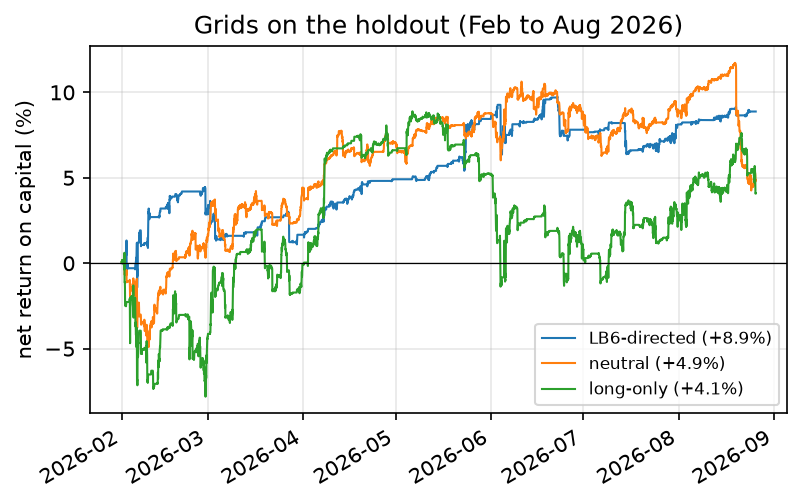
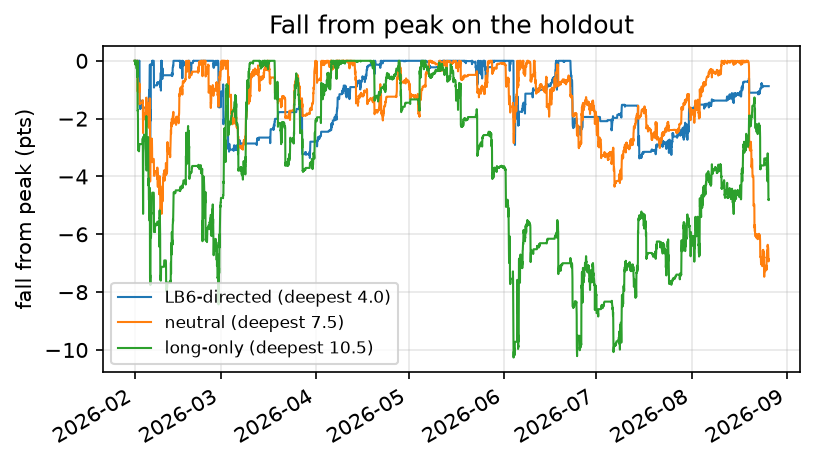
On the data kept aside for this test, yes: a grid whose buy or sell side follows LB6 returns +8.9% on its capital, and its worst fall from a peak is 4.0 percentage points of capital, against +4.9% and 7.5 points for a plain grid. The margin is fragile, though: until the last week of the data the two were close.
The idea
pak Yon's request: run a grid (a ladder of orders that earns a small step on each dip and bounce) but let LB6 decide its side. While LB6 is net long, the grid only buys; while LB6 is net short, it only sells; while LB6 holds nothing, there is no grid. The hope is that LB6's direction turns a grid's trading volume into profit.
LB6 is a BTC trading system at PekkaLabs with 6 engines, three long-only and three short-only. "Net long" means more long engines hold a position than short ones.
What it was compared with
Two plain grids that ignore LB6, with exactly the same settings:
- a neutral grid: a buying grid and a selling grid side by side, half the capital each;
- a long-only grid: buying only, all the capital.
The comparison uses efficiency: total return divided by the worst fall from a peak, counting open positions minute by minute. The LB6 grid had to beat the better of the two plain grids. That rule, and every setting, was written down and saved before any grid touched this data.
The data
BTC perpetual futures, minute by minute, from Binance's public archive, 1 February to 26 August 2026. This stretch was kept aside on purpose: all settings were chosen on earlier data (step 0.5%, range 3% each way, fees 0.02% and 0.05%). It is used once, for this test.
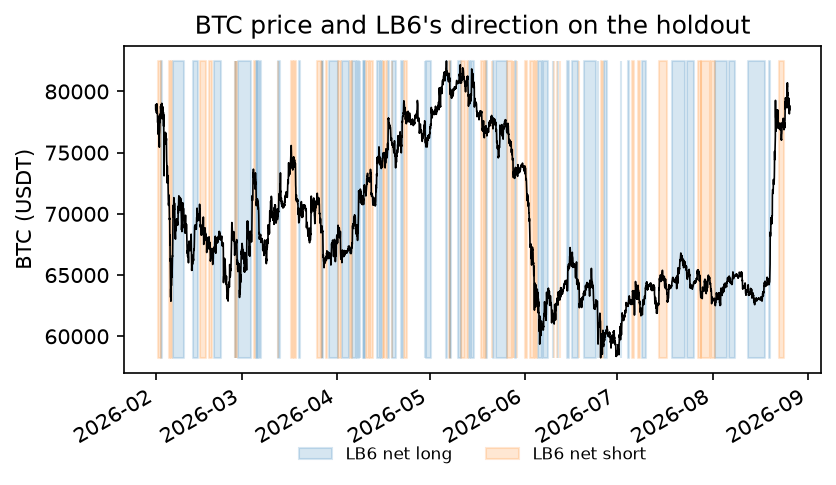
BTC ended this window almost where it started (-0.2%), after swinging between about 58,000 and 83,000. LB6 was net long 33% of the time, net short 16%, and flat 51%.
The LB6 grid wins
| LB6 grid | neutral grid | long-only grid | |
|---|---|---|---|
| return on 1,000 USDT | +8.9% | +4.9% | +4.1% |
| worst fall from peak | 4.0 pts | 7.5 pts | 10.5 pts |
| efficiency | 2.22 | 0.65 | 0.39 |
| volume traded | 137,000 USDT | 232,000 USDT | 232,000 USDT |
| maker fee it can afford and still break even | 0.10% | 0.05% | 0.04% |
It is LB6's direction that matters
A fair worry: the LB6 grid sits idle half the time, so maybe it only looks safer because it trades less. Two extra checks, run after the result was known and not part of the original test, answer that:
- Same idle times, opposite side to LB6: -15.0%.
- Same idle times, a random side for each LB6 stretch, 10 times: none reached the LB6 grid's 2.22; the middle one scored -0.25, and the best, 0.89, would still have beaten the neutral grid's 0.65.
So the gain comes from LB6 picking the side, not from sitting out.
But the margin is fragile
For most of April to August the neutral grid was ahead on return (see the chart above). Up to 18 August, before BTC's sharp rally in the last week, the two were close: efficiency 2.26 for the LB6 grid against 2.07 for the neutral grid, and the neutral grid had the higher return (+11.5% against +9.0%). The final week, where the neutral grid's selling half lost against the rally, made most of the difference.
What it means
Letting LB6 choose the grid's side made it safer and more profitable here, and the direction checks say LB6's side is doing real work. But one test window, decided largely by its last week, is not enough to plan capital on.
Two things matter for pak Yon's goal of volume:
- The LB6 grid trades only 59% of the neutral grid's volume, because it stands still when LB6 is flat.
- It survives much higher fees: it breaks even up to a 0.10% maker fee, so the exchange's rebate (a payment for adding resting orders, which pak Yon's volume target is after) is a bonus rather than the source of profit.
Later check: how much the result depends on timing
A later report, "How much does a simulated grid's result depend on when it starts?", tested how much luck of timing is in these numbers. Started at each of 24 hours on 1 February, the plain grids' efficiency ranged from -0.58 to 0.82 (neutral) and -0.44 to 0.60 (long-only). Acting on LB6's direction 0 to 55 minutes late moved the LB6 grid's efficiency from 0.75 to 4.83. In 11 of those 12 runs it stayed above 0.82, the best any plain grid reached. So the LB6 grid usually wins, but by how much is very uncertain: the 2.22 above is one draw.
Limits
- LB6's own settings were chosen by pak Yon on data that may include this window, so LB6 itself is not untouched here, even though the grid settings are.
- The grid is a model of Hummingbot's executor on minute bars, not the executor; it has not yet been checked against a Hummingbot backtest. A second, independent implementation written from the same specification gave identical numbers, which rules out coding slips but not a shared modelling choice.
- One set of grid settings, one window.
- How pak Yon weighs volume against profit is not confirmed.