Do LB6's stop-losses pay for themselves?
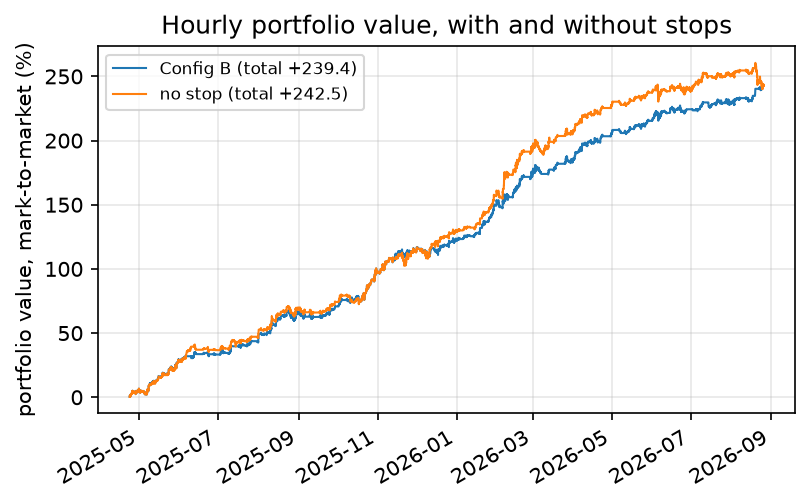
Yes. Without stops LB6 ends with about the same total return (+242.5% vs +239.4%), but its worst drawdown more than doubles, from 8.6 to 20.5 points.
What LB6 is
LB6 is a BTC trading system at PekkaLabs. It runs 6 small strategies, called engines, side by side. Each engine trades one direction only: three only go long (bet the price rises) and three only go short (bet the price falls). The data here is a simulation of the latest version, Config B: 337 trades from April 2025 to August 2026.
Every engine has a stop-loss: if the price moves against a trade by a fixed amount, between 3.5% and 8.0% depending on the engine, the trade is closed at once. Otherwise a trade closes when the engine's own exit condition on the options data is met (its native exit), or when a fixed take-profit level is hit.
Where the question comes from
Only 19 of the 337 trades were closed by a stop. But those 19 account for 85.9 of the 186.6 points lost by all losing trades: almost half.
That can mean two opposite things. Either the stops are cutting trades that would have recovered before the engine's own exit, or they are preventing much larger losses. The question is which one is true.
How it was tested
The full LB6 simulation was run twice with the original simulation code from PekkaLabs' repository: once as is, and once with every stop switched off. Everything else stayed the same: the same entries, the same exit signals, the same take-profits.
Returns here are in points: the sum of each trade's % return, after fees. The two runs were compared on efficiency, measured as the Calmar ratio: total return divided by the worst drawdown. Drawdown is the deepest fall from a previous peak. Here it is measured every hour and includes trades that are still open, because a stop exists precisely to cap losses on open trades. Counting only closed trades would hide them.
The pass criterion was written down and saved before either run: removing the stops counts as better only if efficiency goes up.
Without stops, the total barely changes
The run without stops is ahead in 99% of the hours of 2026, by about 20 points from April onward. The last trade of the data wipes out most of that lead, and it ends at +242.5%, against +239.4% with stops.
But the drawdown more than doubles
With stops, the worst fall from a peak is 8.6 points. Without stops it is 20.5 points. Efficiency drops from 28.0 to 11.9, so removing the stops fails.
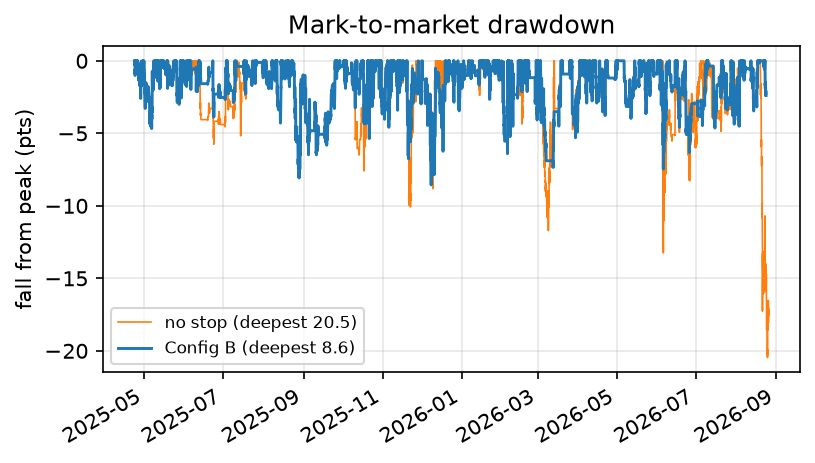
Most of that 20.5 comes from a single trade: a short opened on 17 August 2026 that the stop closed at -5.1%. Without the stop it ran to -23.5%. Even leaving that trade out, the worst drawdown without stops is 13.2 points (June 2026), against 8.6 with them (December 2025). The drawdown is still deeper without stops.
Most stopped trades would have recovered, but not the ones that matter
Of the 19 stopped trades, 12 would have ended better without the stop (one of them by only 0.02 points), and 3 would even have ended in profit. The other 7 would have ended worse, and those include the largest losses: -23.5% and -8.9% instead of the stop's -5.1% and -3.6%.
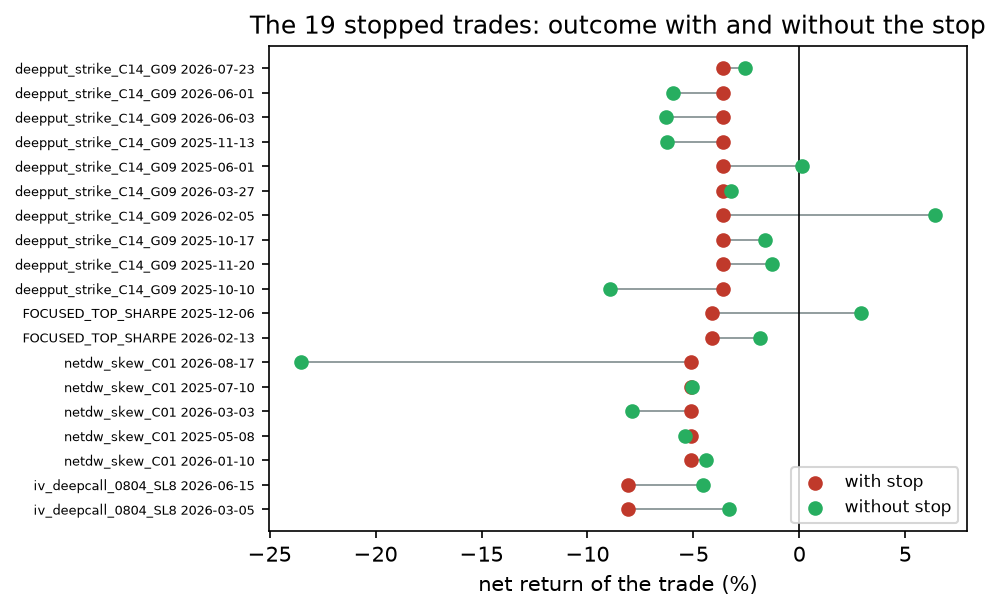
So the stops do cost something on most of the trades they close. What they buy is protection from the rare trade that keeps going the wrong way, and that protection is worth more than what they cost.
What it means and what comes next
LB6's stop-losses pay for themselves. Removing them is not an option.
The stops are not equally useful across engines, though. Without stops, three engines end with a higher total (FOCUSED_TOP_SHARPE, deepput_strike_C14_G09, iv_deepcall_0804_SL8), and one ends much lower (netdw_skew_C01, because of the August trade). That suggests testing a wider stop one engine at a time, starting with those three, with each test's pass criterion written down first.
Limits
- All numbers come from the same simulated data. The real test is new data after August 2026.
- Prices: entries and engine exits use the BTC price in the options data; stops, take-profits and the hourly drawdown use Binance hourly prices from Binance's public archive. Only the forced close at the very end of the data (the 17 August trade, closed on 26 August) needed a price from outside the simulation's own files; it uses the Binance hourly price for that hour.
- The deciding measure, worst drawdown, is driven by the single worst moment. One bad trade is enough to move it, which is what stops are for, but it also means the result rests on few events.
- "Total return" is the sum of each trade's %, after a 0.05% fee per side. Real position sizes and leverage are not modelled.
- An independent second implementation, written without sharing any code, produced the same numbers.