Are Polymarket's 15-minute BTC prices honest probabilities?
Yes, closely. Across almost 34,000 markets, when the "Up" side traded at about 35 cents ten minutes before the end, BTC ended up 35% of the time, and every price level matched within a few percentage points. Where there is a gap, it is mostly that likely outcomes happen slightly more often than their price says.
What these markets are
Polymarket is a prediction market: people buy and sell shares that pay 1 USDC if something happens and nothing if it does not. One recurring market asks, every 15 minutes, "Bitcoin Up or Down?": the Up share pays 1 if BTC's price at the end of the 15 minutes is at or above its price at the start, and the Down share pays 1 otherwise. There are 96 such markets a day. The settlement price comes from Chainlink, a price feed that averages BTC's price across exchanges.
Because an Up share pays 1 or 0, its price can be read as the market's probability that BTC ends up. A price of 0.30 says "30% likely".
Why measure this
This research looks for edges in BTC trading, and these short markets are a new place to look. The next question is whether their prices lag BTC's own price, which a faster trader could use. Before that, a simpler question: are the prices any good as probabilities at all? If 0.30 shares won 50% of the time, the market would be wrong in a way anyone could see.
How it was measured
- Every 15-minute BTC market from 13 September 2025 (the first one) to 31 August 2026: 33,791 markets. Later markets are kept aside for a decisive test.
- Prices: Polymarket's public price history, one point per minute. Outcomes: which side Polymarket paid out.
- The Up price was read at three moments: 10, 5 and 1 minute before the market ends. 102 to 121 markets at each moment had no price in that minute and are left out.
- Markets were grouped by that price in steps of 0.1 (0.0 to 0.1, 0.1 to 0.2, and so on). In each group, the average price is compared with the share of markets that actually ended Up. If prices are honest, the two match. The gap is the share that ended Up minus the average price, in points (percentage points): a gap of +0.021 is 2.1 points.
- The Brier score sums this up: the average squared distance between price and outcome (1 for Up, 0 for Down). Always quoting 0.5 scores 0.25; lower is better.
Prices match outcomes closely
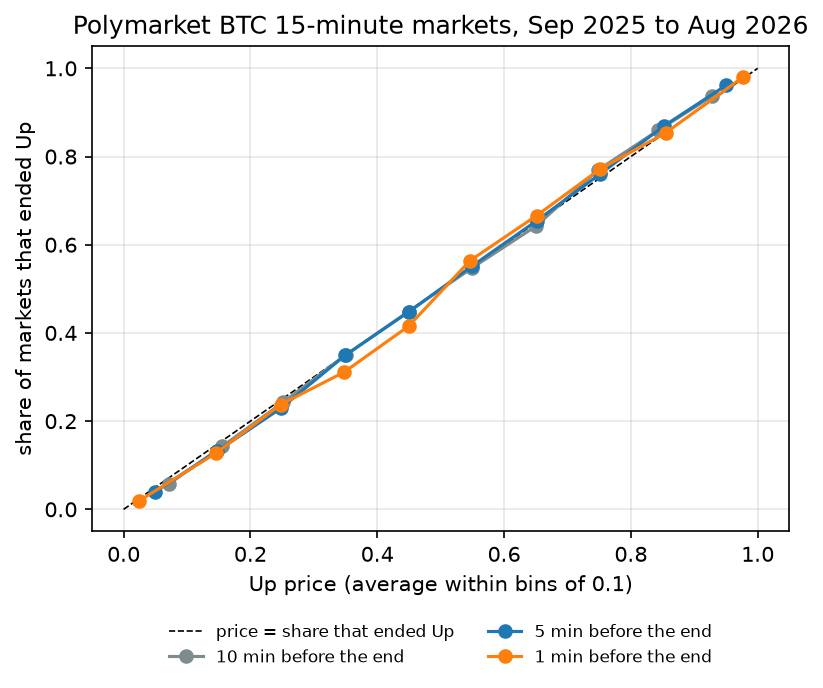
Each dot is one group of markets. On the dashed line, the price equals the share that ended Up. All three moments sit close to the line. Over all 33,791 markets, 49.9% ended Up.
| minutes before the end | Brier score | largest gap in any group |
|---|---|---|
| 10 | 0.201 | +0.021 (prices 0.7 to 0.8) |
| 5 | 0.136 | -0.019 (prices 0.2 to 0.3) |
| 1 | 0.070 | -0.037 (prices 0.3 to 0.4) |
The score falls as the end nears because more of BTC's 15-minute move has already happened.
The small gaps lean one way
At 10 and 5 minutes before the end, groups priced above 0.7 ended Up up to 2 points more often than their price (gaps +0.9 to +2.1 points), and groups priced below 0.3 ended Up up to 2 points less often (-0.9 to -1.9). At 1 minute the gaps are larger (up to 3.7 points) and mostly lean the same way. Likely outcomes were slightly underpriced. Each gap alone is small: the largest picked from 30 groups will usually look bigger than chance, so this is a hint, not a finding.
If it is real, there are two different explanations, and they matter for what comes next:
- Traders are slow or cautious. Prices lag BTC's move, or people overpay for long shots. That could be traded.
- The price history is recorded late. These are Polymarket's once-a-minute history points. If each point reflects the market a little before its timestamp, it trails BTC's latest move and shows this lean, with no trade to be had. A rough check on the same points supports this: a simple probability built from Binance's price matched them better when Binance was taken one minute before each point's timestamp than at the same moment (correlation 0.98 against 0.93, at 5 minutes before the end).
The next report uses individual trades, timed to the second, to tell the two apart.
Limits
- Prices are once-a-minute points from Polymarket's history. Polymarket does not document whether a point is the last trade or the middle of the order book, nor exactly when it was taken. They are not the prices one could actually have bought at; spreads and fees are not included.
- Markets without a price in the measured minute (about 0.3%) may be the quietest ones.
- The settlement rule changed during the period (from Chainlink's BTC/USD price to a 60-second average of it).
- One market type (15 minutes); the 5-minute, hourly and daily markets were not looked at.