Does the best simple rule on trader positioning beat holding BTC?
No. The best of 3,888 rules looked far better than luck on 2020 to 2024, and then lost 20% on the 22 months it had never seen, while simply holding BTC lost 2%. Its edge on 2020 to 2024 came almost entirely from stepping aside during the 2022 crash, and did not repeat.
What was searched
PekkaLabs's LB6 system trades BTC with rules of a simple shape: "go long when measure A is above some level and measure B is below some level". Its measures come from options trading. This search used the same shape on four public measures of how BTC futures traders are positioned, from Binance's archive:
- funding rate: what traders holding long positions pay those holding short ones, every 8 hours. High when longs are crowded.
- change in open interest over 24 hours: whether new positions are being opened or closed.
- long/short account ratio: how many trader accounts are long for each one that is short.
- taker buy share: the part of each hour's volume bought by traders in a hurry.
Each rule takes two of the four, a cut-off for each (from the 10th to the 90th percentile of its values), a direction for each (above or below), and a side (long or short). A position opens the hour after the rule is true and closes 24 hours after it was last true. Fees (0.05% each way) and funding payments are included. That makes 3,888 rules.
Everything, including how the winner would be judged, was written down and agreed before the search ran. The period from January 2025 to October 2026 was kept untouched for one final test.
The best rule on 2020 to 2024
Long BTC when open interest has not fallen more than 2.8% in 24 hours and the long/short account ratio is at most 1.72. In plain words: hold BTC, except when many more accounts are long than short, or when positions are being closed fast.
From September 2020 to December 2024 it made +396% with a worst fall of 31 points (percentage points of capital): an efficiency (return divided by worst fall, called Calmar in the compact view) of 12.8. Rules needed at least 71 trades to count, so that about 30 would fall in the final test. Holding BTC made +292% with a worst fall of 126 points, efficiency 2.3.
Far better than luck on that data
The best of 3,888 rules will always look good by chance. To measure how good chance looks, the same search was run 100 more times on scrambled data: the four measures were shifted in time against the price by at least 30 days, so their own patterns stayed but no longer lined up with the price.
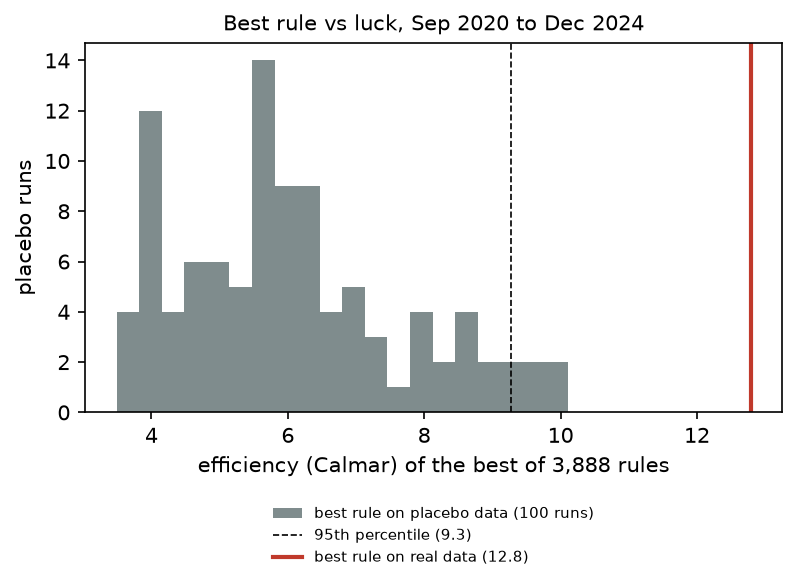
The best scrambled rule scored 5.8 in a typical run and 10.1 at most. The real winner, 12.8, beat all 100. Rules with slightly different cut-offs also did well (efficiency 7.3 to 12.4). The locked check only asked that their middle value be above zero, a weak bar, but they cleared it easily. Both checks passed, so the rule went to the final test.
On data it had never seen, it lost
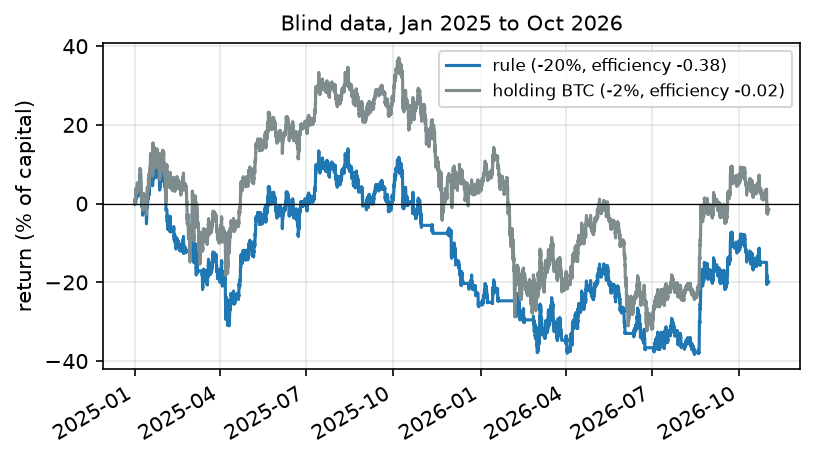
From January 2025 to October 2026 the rule lost 19.9%, with a worst fall of 52 points, on 60 trades. Holding BTC ended at -1.5% with a worst fall of 69 points. The rule's efficiency was -0.38, below both holding BTC (-0.02) and zero, so the bet failed. (Efficiency below zero is awkward to compare, since a deeper fall makes it less negative; here the rule both lost more and fell less deep than holding, and failed either way.)
Why it passed the checks and still failed
The scrambled runs used the same BTC prices, so they already enjoyed the same rising market; a rising market alone cannot explain why the real rule beat them. A check made after the result points elsewhere: the rule's edge came almost entirely from one year.
| year | time in a position | BTC while in | BTC while out |
|---|---|---|---|
| 2020 (Sep to Dec) | 95% | +105% | -11% |
| 2021 | 47% | +113% | -29% |
| 2022 | 63% | +14% | -96% |
| 2023 | 74% | +102% | +1% |
| 2024 | 78% | +110% | -16% |
| 2025 | 80% | -17% | +20% |
BTC moves here are hourly moves added up, not compounded, so they can pass -100%.
The rule mostly holds BTC and steps aside when many more accounts are long than short. In the 2022 crash, stepping aside avoided most of the fall: 96 of the 151 points it avoided over 2020 to 2024. In other years stepping aside mattered little, and in 2025 it was wrong, missing a 20-point rise. One episode, not a lasting pattern, carried the rule past the checks. The scrambled runs could not catch this because they measure how good the best rule can look by chance, not whether its gains are spread over time.
What it means
- The best simple rule on these four measures did not find an edge that lasted; nothing here says no rule on this data could. The test data has now been used for this kind of rule on BTC futures, and is no longer blind for it.
- The checks on 2020 to 2024 did not catch the rule; the single final test did. That is why it exists.
- The next search should add a check that the winner's gains are spread across years, not carried by one episode, before it may use blind data.
Limits
- One rule shape (two measures, 24-hour hold, no stop), four measures, one exchange.
- The top five rules on 2020 to 2024 were seen once, in a run to time the search, before the search was locked; the final test was not.
- The yearly breakdown above was made after the result.
- Funding is the published rate at each settlement; positions are sized at 1x and returns are summed, not compounded.